
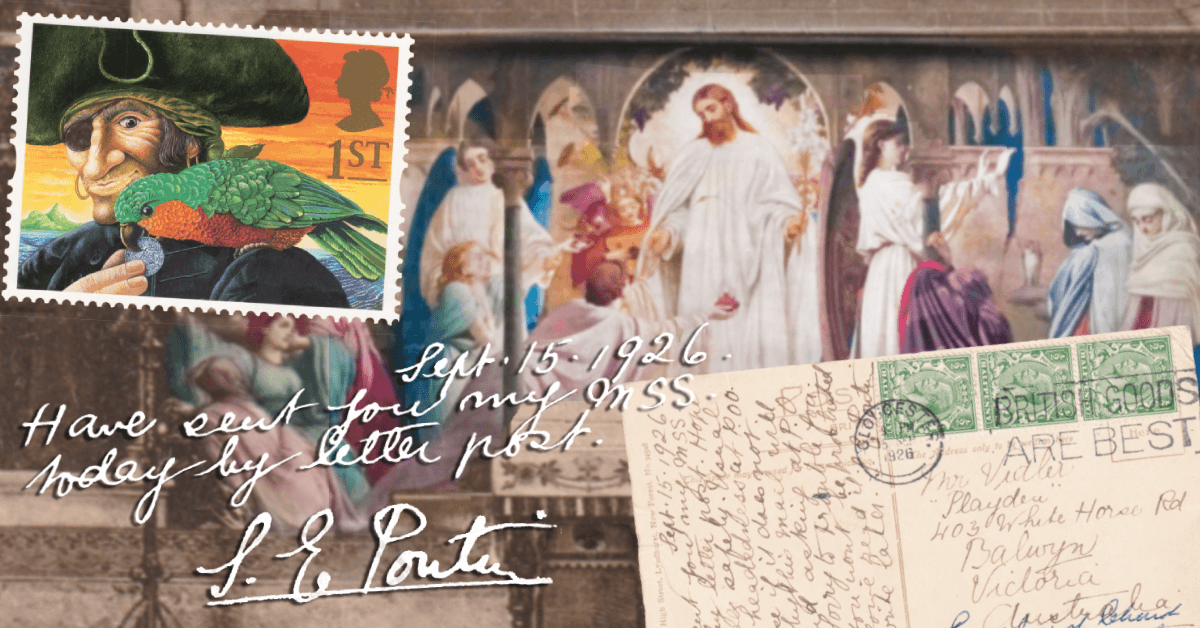
My last blog post explored an old postcard that led me into a world inhabited by artistic, literary and political personalities of the 1920s. Well, there was a second postcard in that random box of stuff. This second card also entertained me with its connections to various notable people from the past – but then, in an unexpected twist that left my mouth on the floor, I discovered its very close ties to an all-time literary classic. It also left me with an intriguing mystery that remains unsolved. Maybe you can help me? Let’s dive in!
Down the rabbit-hole
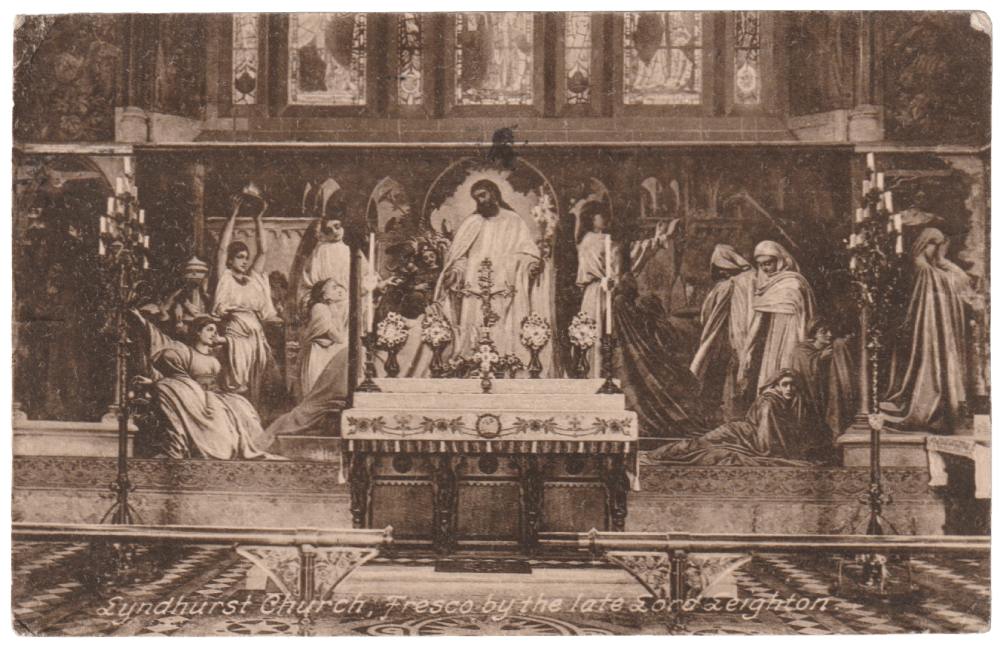
Mailed from Gloucester in England, postcard number two features a sepia photograph—complete with unfortunate ink blot—of a fresco at St Michael and All Angels church, further south in Lyndhurst, Hampshire. It depicts the Parable of the Wise and Foolish Virgins, also known as the Parable of the Ten Bridesmaids. This parable is told by Jesus in the Gospel of Matthew; long story short, if your job is to wait for a bridegroom who’s due to arrive during the night, make sure you take extra oil for your torch.
No offence to 1920s technology, but it looks much better in colour.
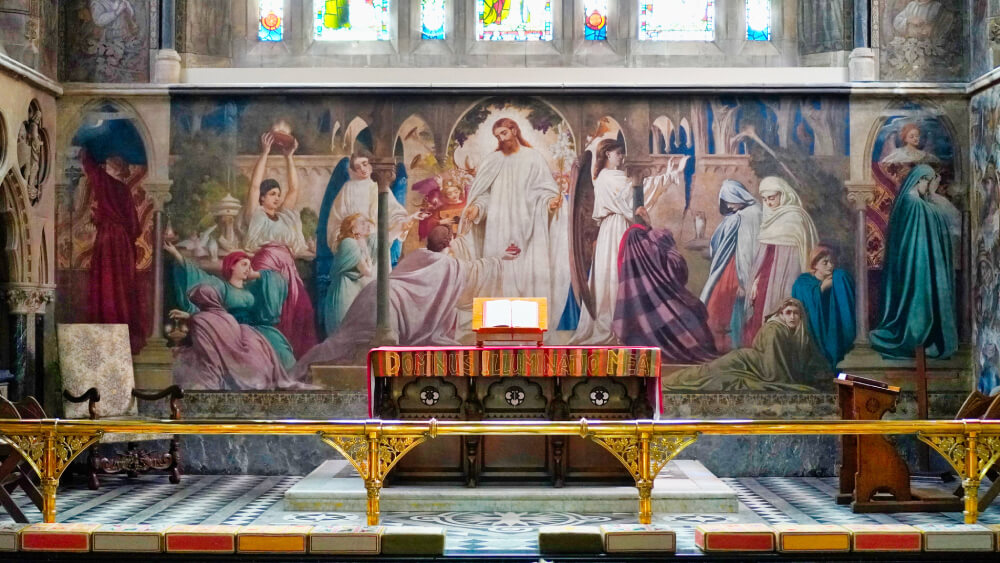
I feel sorry for the foolish bridesmaids, all glum on the right-hand side of the fresco while the goody-goody bridesmaids on the left wave their extra oil in their faces. We all know what it’s like to live through an oil shortage. There’s even a bouncer angel holding them back. No oil, no VIP meet-and-greet for you!
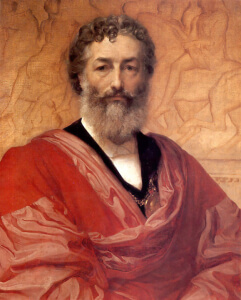
The fresco was painted by Lord Frederic Leighton, whose biography took me down my first rabbit hole before I realised how appropriate that phrase was to become. He was a very popular 19th-century painter of Biblical and classical themes, and president of the Royal Academy for two decades. He holds a hilarious record in the British honours system: in 1896, Queen Victoria waved her magical Queen wand and declared him Baron Leighton of Stretton. The patent that officially brought this about was issued on 24 January, and then—wait for it—Baron Leighton died the next day. His baronetcy was not hereditary, so it expired with him; its duration of one day makes Leighton the holder of the shortest-lived peerage in history.
Lord Leighton reputedly used local people as models for the characters in his fresco, but to digress for a moment, it’s a local outside that same church who brings in the tourists these days. Long before the ashes of “Mrs Reginald Hargreaves” were ignominiously interred under her husband’s name, she was none other than Alice Liddell, the child widely thought to have inspired the heroine of Lewis Carroll’s Alice’s Adventures in Wonderland.
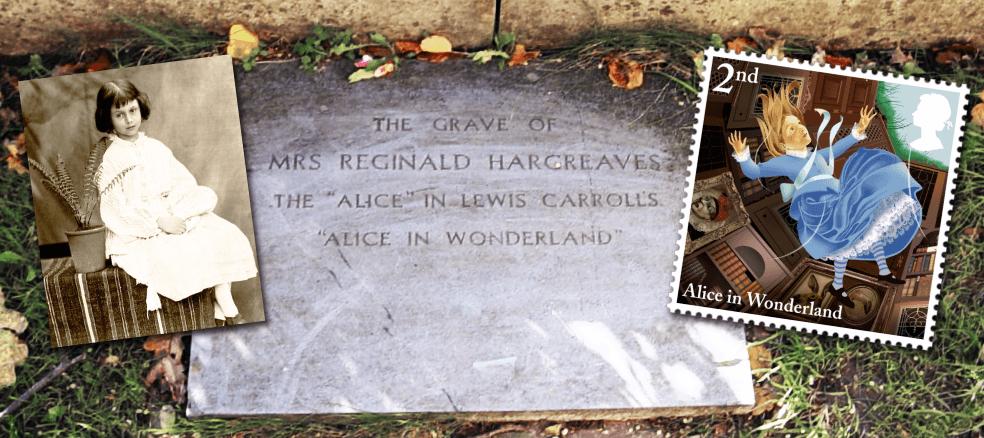
It’s a matter of dispute just how much Alice Liddell really inspired ‘Alice’, but I think it’s time to leave the rabbit-hole and climb back to the surface.
Poetry in motion
The postcard was mailed to a “Mr Vidler” in Balwyn, which is a suburb of Melbourne, Victoria, Australia. Even as a Melburnian myself, I wasn’t familiar with Mr Vidler, but it didn’t take long to track him down.
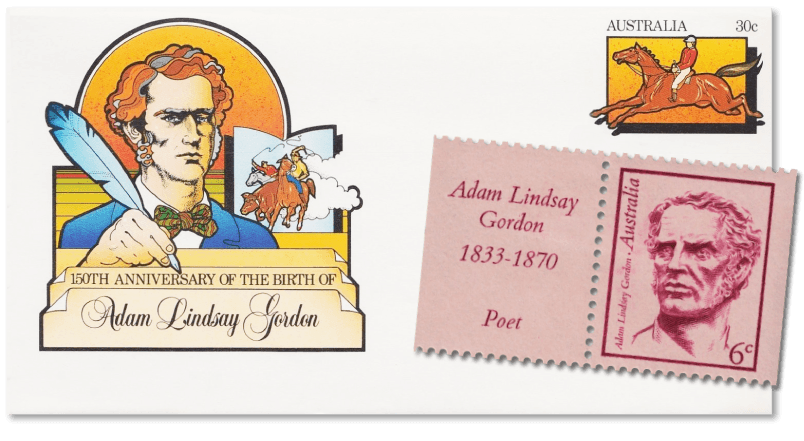
Edward Vidler was a journalist, editor and publisher who began his career in London in the 1880s before emigrating to Australia in 1888. After a period running regional newspapers, he moved to Melbourne where he promoted and published local artists and writers for many years. This included publishing a posthumous anthology of the poet Adam Lindsay Gordon, who could handle a horse almost as well as he could handle a quill, so he qualifies for a stamp AND a pre-stamped envelope.
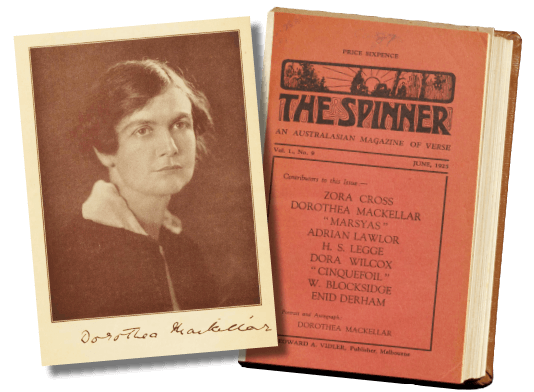
Vidler’s attempts to promote Australian verse included publishing the magazine The Spinner in the 1920s; it seems this was not a financially viable venture, and it folded. You might recall that this was the same fate that befell Lilley’s Magazine, founded by Norman Lilley, the recipient of the last postcard I wrote about. I don’t know who owned the mystery box that I bought at this stamp auction, but they seemed to have a weird thing for failed poetry publishers.
The Spinner published many works by female writers when this was still considered unusual. As I browsed the magazine (shoutout to the National Library of Australia’s excellent archival platform, Trove) I was intrigued to see that the ninth edition featured a poem by Dorothea Mackellar, along with a “portait and autograph” of the poet. Could it be? Could Edward Vidler have discovered Dorothea Mackellar?
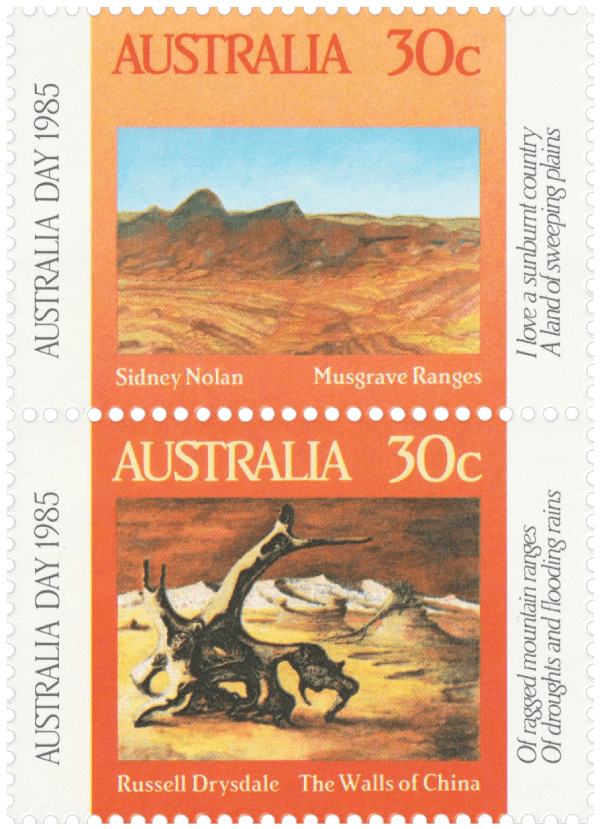
Most non-Australian readers would not have heard of Mackellar, but she holds a beloved place down under, thanks to her poem My Country (originally titled Core of My Heart). Written at a time when many Australians still thought of Britain as ‘home’, it’s a defiant rejection of England’s “green and shaded lanes” in favour of the southern continent’s “beauty and her terror”. Mackellar began the poem aged 19 while visiting London, and finished it after returning to Sydney. Many Australians can recite the first few lines of the second verse – indeed, many of us erroneously think the poem is called “I love a sunburnt country.”
I love a sunburnt country,
A land of sweeping plains,
Of ragged mountain ranges,
Of droughts and flooding rains.
I would love to tell you that Australians know this poem because underneath our brawny, roughneck exterior, we secretly can’t get enough poetry and discuss it with each other all the time, but the truth is, we mainly know this poem because voiceovers read it aloud in ads when they’re trying to sell us something.
Oh, and one time, we put it on some stamps!
I once chanced upon the grave of Dorothea Mackellar when I was exploring a picturesque Sydney cemetery years ago. She lies buried just a short distance from none other than… HENRY BLOODY LAWSON!
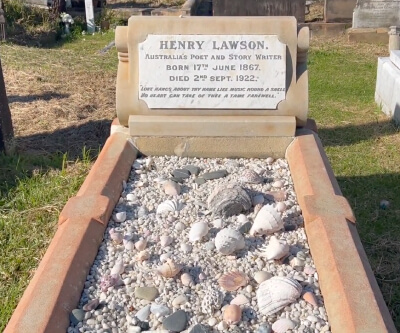
That non-sequitur was a deep cut for readers who enjoyed Postcard #1. While I’m at it, Mary Gilmore was also published in The Spinner, and Arthur Streeton named one of his paintings after a poem by Adam Lindsay Gordon. This post has become one of those sequels where they give the original cast some cameo appearances to justify you showing up again.
Anyway, I eventually learned that Dorothea Mackellar was famous long before Edward Vidler started The Spinner. It’s cool that he worked with her, but I kinda really wanted to be able to tell you that this postcard was addressed to the guy who discovered her.
But that was before I stumbled on Edward Vidler’s most extraordinary contribution to literature.
Discovery by candlelight
For this, we must retrace his steps back to his days as a young editor at Cassell’s publishing house in London in the 1880s. A so-called ‘manuscript’ had arrived; in fact, it was a foolscap exercise book, scrappily packed with the pasted-in chapters of a serialised story from a badly-printed boys’ penny magazine. From a 1927 edition of the Bulletin (Australia), Vidler takes up the story:
This apparently had lain neglected for some time on the desk of the chief of the editorial department, Mr. John Williams, a mere business man of no literary ability or imagination, and there it might have remained neglected still further—for it was a very unalluring affair—but for my chance call on him one day. My youth, no doubt, suggested to him that he had a “reader” ready at hand. When I had got the instructions I asked for and was leaving, he picked up the exercise-book and handed it to me, saying, “Take this and let me know what you think of it. It’s a boys’ story. Let me know to-morrow if it is any good.”
I took it home, not expecting anything more of it than of the numerous other manuscripts I had read for the firm—l suppose I was given the obvious “duds”—but dutifully sat down after my evening meal to look at it at least. From the first it gripped me … “The Sea Cook” was, I soon found, very much more than a mere boys’ story. The well-contrived “atmosphere” of the thing, its amazing lifelikeness, its picturesqueness, the vividness of its characters, that awful blind Pew especially, had a quality about them quite different from anything I had read before. It had a strange spell which compelled me to persist in reading the smudged small type, the rough paper often creased in pasting it down, sometimes consequently almost undecipherable.I held on right through until it was finished, though my eyes ached and I had to light my bedroom candle when the gas was turned off at the main by my thrifty landlady. I even re-read the first part before putting it down reluctantly and going weary to bed. Next morning I was on the watch for Mr. Williams’s usually late arrival. I followed him into his room, taking no notice of his exclamation of disapproval, and poured out a volley of enthusiastic comment, so that he stared at me surprised and then smiled tolerantly as he turned his attention to his correspondence.
Convinced by the young Vidler’s enthusiasm, his boss published the book as a novel – but not as ‘The Sea Cook’. In the scrapbook, the author had drawn a rough map and scrawled beneath it a caption that became the novel’s title.
And that’s how I learned how the recipient of my postcard brought about the publication of Robert Louis Stevenson’s classic adventure novel Treasure Island. It has sold over 100 million copies since.
It’s hard to overstate how much this novel influenced Western culture’s ideas of pirate life. If Edward Vidler hadn’t squinted his way through that scrapbook full of cuttings one night in 1883, we would never have had pirates with wooden legs, parrots squawking “Pieces of eight!”, and, of course, about four thousand stamps.
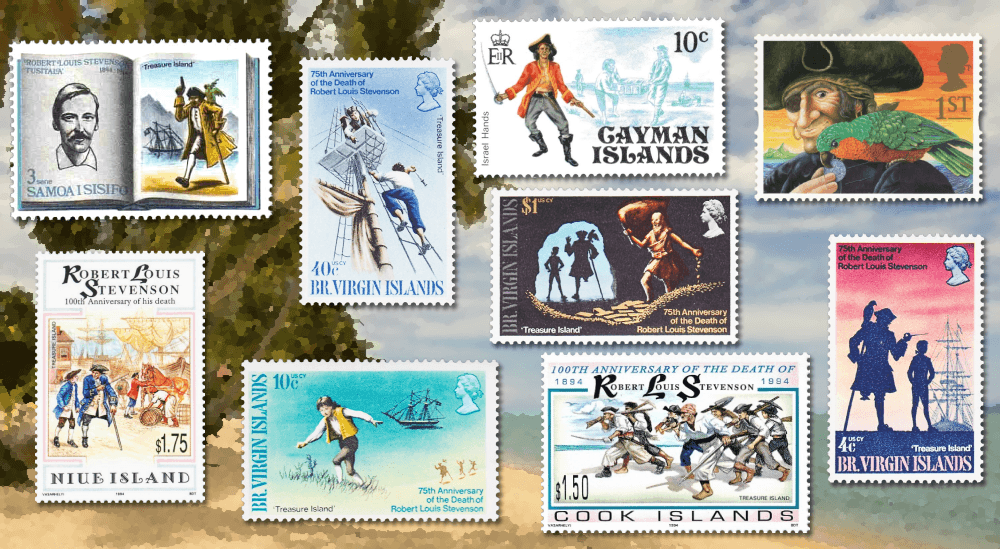
I could go on about Edward Vidler’s influence on Australia’s arts scene, his naturalism and legacy in Australian flora and fauna, his telepathic dog, and his memoirs of the celebrities he encountered. (Oscar Wilde “spoke in a melodious drawl, a long-drawn monologue, but evidently not brilliantly, for I remember nothing of what I heard him say.” Mee-oww!)
But let’s move on to the sender. Because this is where I need your help.
Writing a mystery
This is a much busier postcard than #1.
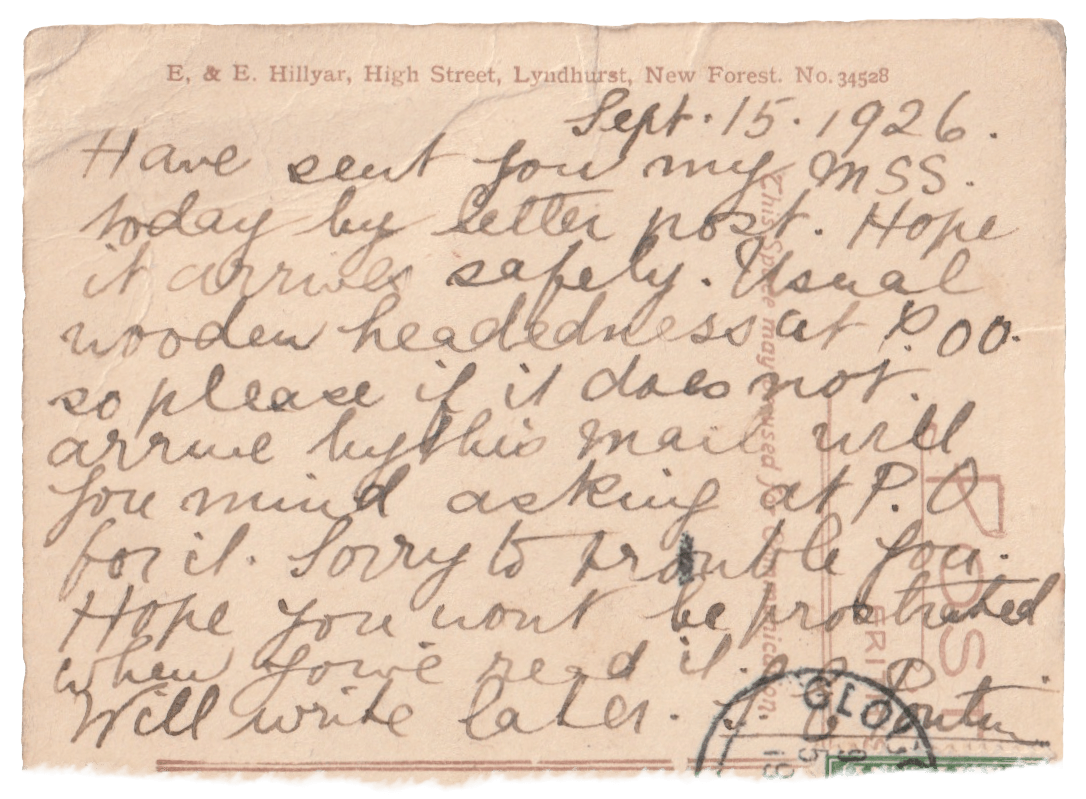
Sept. 15. 1926.
Have sent you my MSS. today by letter post. Hope it arrives safely. Usual wooden headedness at P.OO. so please if it does not arrive by this mail will you mind asking at P.O for it. Sorry to trouble you. Hope you won’t be prostrated when you’ve read it. Will write later. S. E. [Ponting? Porter? Pouter?]
MSS means ‘manuscripts’, so presumably this is a writer who has sent some works off to the publisher. The informality here suggests that it’s not the first time the two have done business. The “usual wooden headedness at the P.OO” is funny – that appears to be a reference to the Postal Order Office, a postal branch authorized to issue the postal orders that were widely used in the olden days to send money through the post.
But who WAS the writer? I have probably spent too long studying this signature. Get out your magnifying glasses, my nerd army. What do you make of it?
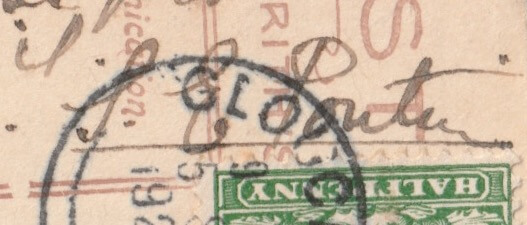
The S is identical to that in the word ‘Sorry’. I’m also pretty confident on the E and the P. There’s almost certainly an ‘o’ after the P, and definitely a ‘t’ in the middle of the surname. The flying dot hovering over the back end suggests that there’s an ‘i’ in there somewhere… unless that’s a hurriedly misplaced final full stop, which it could easily be.
My best guess is ‘S. E. Ponting’, with the tail of the ‘g’ serving as an underline. Or it could be something like ‘Porter’ or ‘Pout(i)er’ with the underline simply a flourish. While writing this article, I even started wondering if there is a tail dangling down under the third letter of the surname – or is that just the postmark? It’s hard to tell.
I couldn’t find anyone published in The Spinner whose name came close to looking like this. I even visited the State Library of Victoria in Melbourne and combed through anything else I could find on Vidler (which wasn’t much). I did manage to get my hands on a volume of poetry that he published three years after this postcard: Poems and Lyrics by someone called G. E. Parker.
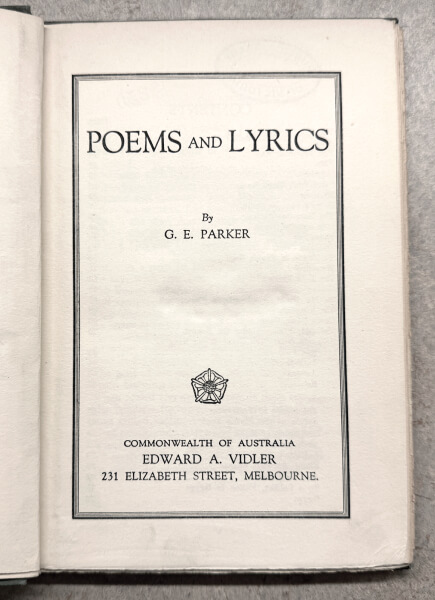
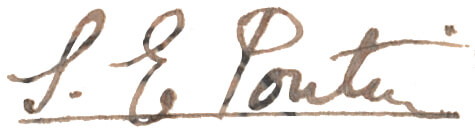
“G. E. Parker.” That couldn’t be our writer, could it? I returned to the signature on the postcard, and I am convinced that it couldn’t possibly say ‘G. E. Parker.’ Right?
Hmm, what else do we know? Our writer posts the card from Gloucester, but we can infer from the card that they had visited Lyndhurst, further south. Is Ponting/Porter/Poutier an Aussie poet backpacking around the green and shaded lanes of the mother country? (Suck on that, Dorothea Mackellar!) Are they an English poet who gains inspiration from regional religious murals, and so desperate to be published that they don’t care if it happens on the other side of the world?
I poked around Gloucester’s poetry scene at the time, without luck. Recalling my success with postcard #1, I tried AI. Google initially declared that “S. E. Ponting was a minor British writer/poet whose name appears in regional literary circles and indices”, which proved exciting; pressed for more information, it added, “I cannot provide sources for a specific “S. E. Ponting” as a poet or minor British writer because there is no such widely recognized individual in established literary indices or historical records.”
Thanks for that, AI. Evidently not brilliant. Edward Vidler would consider you the Oscar Wilde of technology.
Well, I’m tapping out for now. I’ve searched through library catalogues and national archives, Ancestry.com, Newspapers.com, Open Library and anywhere else I can think to look. It might be fair to speculate that nothing came of S. E.’s literary career, but I still want to know where they ended up!
There are small physical archives of Vidler’s correspondences dotted here and there around Australia. I’ll try to keep that in mind and check them out when I’m next in each town. Which, in some cases, could be years from now.
In the meantime, why not throw it out there and see what the internet can discover? Have I missed something that’s staring me in the face? Is there a box sitting in your attic marked “E. Vidler”? Does this postcard remind you of Great-Grandpa or Great-Grandma Porter ranting manically until their dying day in their Gloucester accent about how they would have become a great poet if only that wretched Mr. Vidler had got back to them?
I would love to hear your theories in the comments below or via social media. I’ve given you the map. Help me find the treasure! Well, OK, there’s no treasure, but if you help me get to the bottom of who our postcard’s writer was, I’ll have the King make you a baron for a day.
In closing, I’d like to say a big hello to the modern young adult fiction writer, S. E. Porter, who is going to be very disappointed when this blog entry triggers a Google Alert for her name.
Follow me on Bluesky, Facebook, Instagram, and Threads.
I’m no longer regularly active on ‘X’.
REFERENCES
Frederic Leighton, Wikipedia
Lyndhurst parish church – the current church of St. Michael and All Angels, New Forest Explorers’ Guide
Lurline Stuart, Edward Alexander Vidler (1863–1942), Australian Dictionary of Biography
Leonie Kramer, Adam Lindsay Gordon (1833–1870), Australian Dictionary of Biography
Broinowski, R. A. (ed.), The Spinner (various editions), Edward A. Vidler, Melbourne, Trove, National Library of Australia
Beverley Kingston, Isobel Marion Dorothea Mackellar (1885–1968), Australian Dictionary of Biography
Edward Vidler, ‘Stevenson and Henley’, The Bulletin, Vol. 48 No. 2488, 20 October 1927, p2
Edward Vidler, ‘Canine sagacity’, The Age (Melbourne), Saturday 28 January 1933, p20
G. E. Parker, Poems and Lyrics, Edward A. Vidler, Melbourne
© Philatelic product images remain the copyright of issuing postal administrations and successor authorities
Discover more from Punk Philatelist
Subscribe to get the latest posts sent to your email.

Hi Gerard. I think the surname reads Pontin. However, I don’t think that gets any further forward! Great article
LikeLiked by 1 person
You’re not the only one to think that. I’m sniffing out a lead!
LikeLike
Fantastic detective work, I love reading your work, just as much as I did Treasure Island.
looking forward to your next post
LikeLiked by 1 person
Thanks Nic! More investigations soon…
LikeLike