
Hello and welcome to the new occasional segment I just decided to launch! Here’s how it works: you ask ‘What the…?’ and then I explain a thing. Got that? Great.
So a few years back I joined a local philatelic society. A stamp club. I hadn’t been in a stamp club since primary school, and it’s not something I mention to my normal friends, because we all know how it sounds (except for people who join stamp clubs, many of whom do not realize how it sounds). I also joined the club’s circuit book list.
Stop right there! “Circuit books” – What the…?
Circuit books (also known as exchange books or club books) are an endearing remnant of real ye-oldey-timey stamp collecting. They’re scrapbooks full of stamps and other philatelic material for sale, generally owned by small-time collectors. This is how eBay worked before the internet.
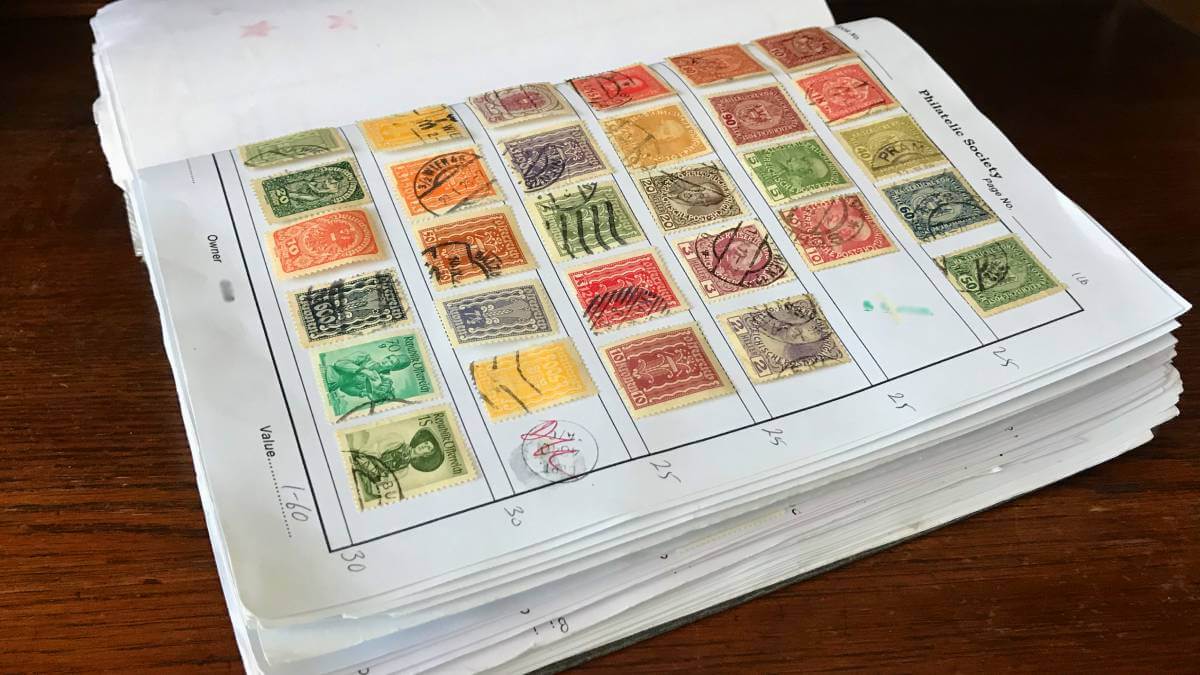
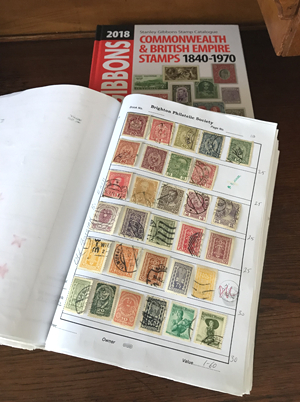
Vendors with lots of time on their hands compile sheets full of stuff they want to sell, annotated by how much they want. Those sheets are compiled into books. Those books are passed around from club to club, and from member to member. Let me take you through my latest delivery, complete with images. (The pics are wonky because of the curves of the pages. The bad lighting is totally my fault.)
An honesty system prevails: you get the books, you take the stuff you want, you pass the books onto the next member on the list, and you send the money to the coordinator of the circuit books. The cash finds its way back to the seller of the stamps, usually with a commission taken by the clubs facilitating the arrangement. (Their commercial siblings, ‘approval books’, are compiled by dealers to send to clients, and they pretty much work the same way.)
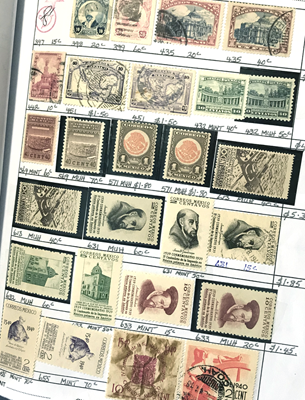
Circuit books have some charming differences to buying online. There are no menus, so you don’t know what lies in wait as you turn each page. If you’re thinking of buying an item, you’re looking at the item, not at a scan or a description.
And, best of all, circuit books can be cheap as! Only an idiot would go to all the hassle of affixing unwanted material into a circuit book sheet and then ask a price for it that makes it impossible to shift.
If there’s one big drawback, it’s that stamp hinges are still very much in vogue in this world. Some compilers will (thankfully) go to the trouble of sticking in stamp panes for stamps to sit in, but you can safely assume (at least in my neck of the woods) that much of the used material, and a good deal of the mint, will come with this remnant of the olden days attached.
To be honest, when I signed up for the circuit books, I didn’t think I’d have much use for them. I already have a cupboard full of stuff I need to offload. And what I AM still buying, doesn’t show up much in circuit books.
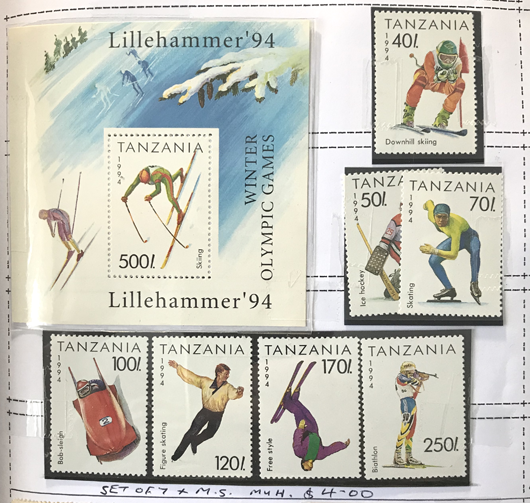
At first, that held true. There was lots of trawling through pages of low-value definitives, or worthless wallpaper stamps from the third world. Who could have known that Tanzania was so into the Winter Olympics?
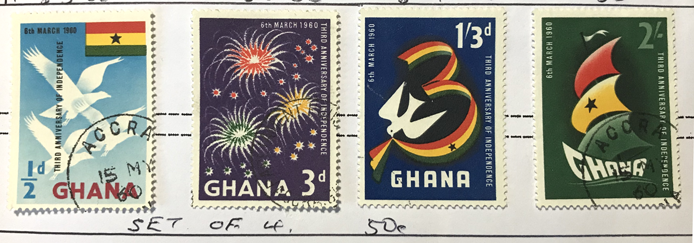
But someone, somewhere, collects that. And anyway, you can also regularly feast your eyes on spectacular issues that wouldn’t normally cross your path. This one celebrating the 3rd anniversary of Ghana’s independence really caught my eye, with its joyful designs and vivid (for 1960) colours.
I turned another page, and this 1990 Papua New Guinea Gogodala dance mask set took my breath away. So gorgeous I nearly took up PNG collecting on the spot. (I’ve done a great job of washing out the colours.)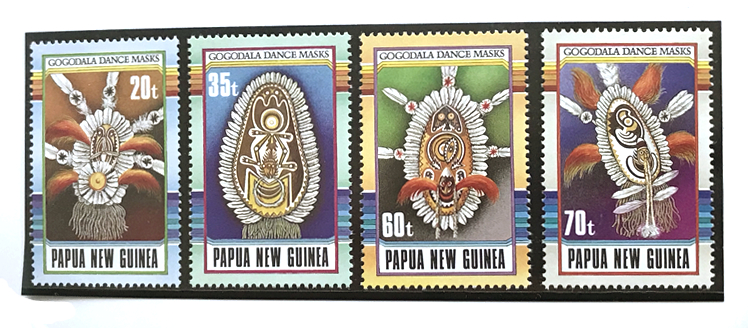
I do have one fun little side-collection that scores regular hits in these circuit books: the Holiday Collection. Stamps depicting locations I’ve been to. You know postcards, right? Like that, but on stamps. Not just from countries I’ve been to – that’s too easy. The rule is, I must have beheld the depicted landscape, edifice or artifact with my very eyes.
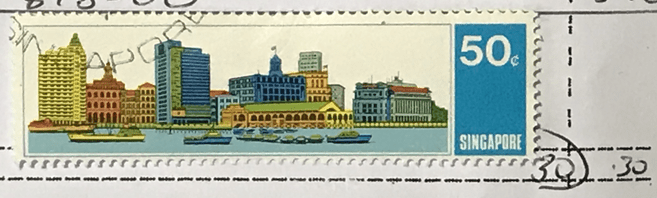
And what do we have here? A 1971 Singapore 50c ASEAN Tourism stamp depicting the Marina Bay waterfront! (I said that like I knew that stamp existed. But I didn’t. Not until I turned the page and immediately recognized the scene. It’s changed a bit since 1971. Way more skyscrapers.) That’s what’s fun about this collection. Suddenly I’m back there, on a humid Singapore night, surveying the colonialist majesty of the Fullerton as I chow down on a chicken rice at Gluttons Bay. Mmmmm, chicken rice.
Page turn, and we’re in the UK. I love modern British stamps and I’ll own them all one day, but not by buying them one-by-one from circuit books. I’ll buy some dead guy’s whole collection at a thrift shop for five bucks when I’m the only stamp collector left alive. In the meantime, circuit books give me a chance to window-shop. Hang on… nearly missed this. In the middle there. Is that… an ancient fire engine?
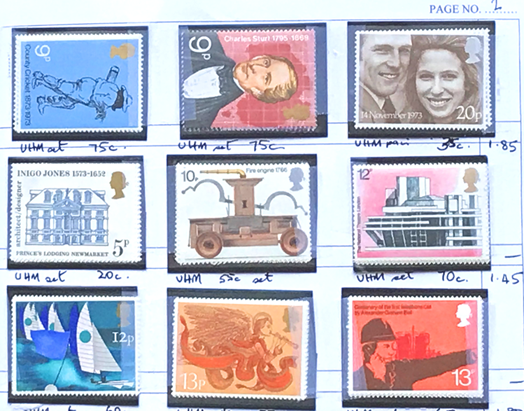
A while back, I just decided that I like stamps with fire engines on them. It’s not an official thematic collection, that would be too much effort. It’s just… I have a page of fire engine stamps, OK? Get off my back.
It took a few minutes of wrestling with adhesive tape while not destroying the whole page, but I’ve earned my reward. All bundled up together, it’s the 1974 Bicentenary of Fire Prevention issue. Let that be a lesson to you, circuit book vendors… too much efficiency with your display, and you might miss a sale. At least put the most eye-catching stamp at the front of the bunch.
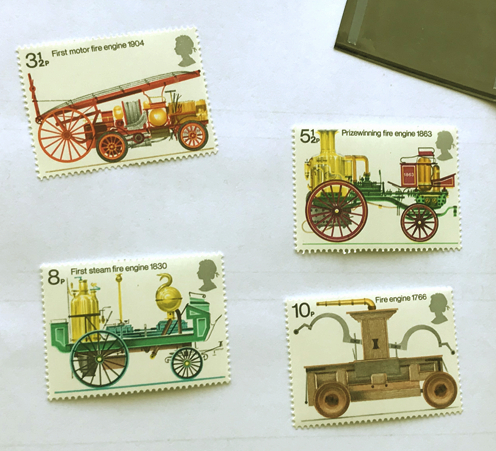
Post script: the same set showed up a few pages later, all four stamps laid out and easily seen. Same price. Phew!
There’s a third reason I sometimes yank something out of these circuit books: the lure of tiny profit, when I find something that I reckon I could get more for. These books are compiled by amateurs, selling stuff they’re not interested in rather than the stuff they know, so there’s always a chance of discovering a sweet nugget for a good price. The dream thousand-dollar rarity hasn’t shown up yet. But a misidentified variety, or an aerogram that was stuck into the book at a ten-year-old catalogue price of $20, which might be worth $70 by the time it gets around to me… yarrr, even if I get $30 for it, there be ten bucks for Punk to spend on fire truck stamps. Woohoo!
So it turns out my initial skepticism was wrong. I DO find things I want in circuit books… because – and here’s the twist – when I signed up to the list, I didn’t actually have a Holiday Collection or a thing for fire engines. They were inspired by the regular practice of leafing through these books and being reminded of the simple pleasure of exploring the world through stamps. It’s a childlike thing to write, but it’s also a childlike thing to experience, and it’s something I’d forgotten in my pursuit of grown-up philatelic goals.

When a new batch of circuit books turns up at the doorstep, it can be challenge to put to one side the life of an average, flustered member of the full-time 21st century workforce and find the couple of hours it will take me to get through them, but I always make it happen. On a cosy, rainy afternoon, pass me a circuit book and a few catalogues, pour me a glass of something nice and let me settle in for my semi-regular dose of zen.
Postscript: two months after I wrote this piece, I came across the same Ghana set, mint, in another circuit book. I loved seeing them again. I took them (for 20 cents less than the lot above). I guess I collect Ghana now.
If you secretly want to know more about philately, it’s OK, you can follow this page and no one will ever know. Or say hello on Facebook, Twitter, or Instagram! And leave your thoughts and questions below! x
© Philatelic product images remain the copyright of issuing postal administrations and successor authorities
Discover more from Punk Philatelist
Subscribe to get the latest posts sent to your email.

Excellent post! Thank you for sharing
LikeLiked by 1 person
You crack me up. And you teach me something new with each post, too! I had no idea circuit books were still a thing. I’ll have to find out if any are making the rounds locally. Also, best wishes on someday owning every modern British stamp ever produced. You can have mine if you want. I accidentally ate raw chicken the other day, so I don’t expect you’ll have to wait long. 🙂
LikeLiked by 1 person
Oh dear! Take care! I’m not in THAT much of a hurry to be the last stamp collector!
LikeLiked by 1 person
Good thing you’re patient, because I’m (surprisingly) still alive. 🙂
LikeLiked by 1 person
I am a firm believer in the Groucho Marx philosophy …I would not join a club that would have me as a member.
At one of the monthly stamp fairs, there is a dealer (part timer of course) trying to sell old circuit books. Some of the stamps look tempting..but it is that curious mix of common definitives, CTOs from Easten Europe and genuinely nice stamps and he is forlornly trying to sell the books at a very inflated price.
LikeLiked by 1 person
ARE THERE ANY FIRE ENGINES??? 😀
LikeLike
great post! I have a TON of stamps, many were my Scottish grandfathers. I have most of them in books by country. Is there a better way to organize? You mentioned themes…is that better?
Also I would like to find a site that I can get values on.
I have old stamps from all over the world
LikeLiked by 1 person
Thanks Ruth and welcome aboard! The joy of collecting is that there are no rules, so there’s no ‘better way’… just the method that works for you. Many collectors sort by country, because it’s probably the most logical and easiest to remember. ‘Themes’ can be a fun way to collect certain topics, but I don’t find it very useful for sorting, because sometimes a stamp can depict multiple themes, so it can pertain to a few different categories. I have even seen albums sorted by colour!
As for value, there are a few sites that function as online catalogues with values, like https://www.stampworld.com/en/ or https://www.freestampcatalogue.com/ or https://colnect.com/en/stamps/catalog, but expect to have to sign up and in some cases, pay for access.
For specific countries, you might be better off getting your hands on a printed catalogue, even one that’s a few years out of date. The brand depends on which part of the world you’re looking at (eg Stanley Gibbons for Great Britain and Commonwealth, Scott for USA, Michel for Germany, Yvert & Tellier for France and colonies). If you’re really lucky, you might have a nearby library that stocks an all-world stamp catalogue, possibly in a few volumes.
However, the thing about the options above is that they show values that a dealer might charge for stamps in good condition. They’re not what you would receive if you were looking to sell them. Furthermore, as you might know, stamps can be tricky to pin down – they can have variations in paper, perforation size, printings, shades, and many other things. It can be hard to be sure you’ve identified exactly the right stamp, especially if you’re new to the field.
For a large inherited worldwide collection, a better start might be to find a dealer, or enquire at a local stamp club, or keep your eyes out for a local stamp fair or exhibition. In any of these cases you should be able to take the albums along for an appraisal. Keep your expectations low! The real-world value of any collection depends on demand and supply for the material, so if the material is widely available or no one’s buying, then even old stamps won’t be worth a lot.
It sounds like you might have had your grandfather’s collecton for a while, but you might still like to watch the video ‘Inherited stamp collection? What to do!’ at the YouTube channel Exploring Stamps. It’s a friendly and useful guide for people who are just like you! https://www.youtube.com/watch?v=44LJFCRntcE
Good luck, and thanks for reading!
LikeLike