
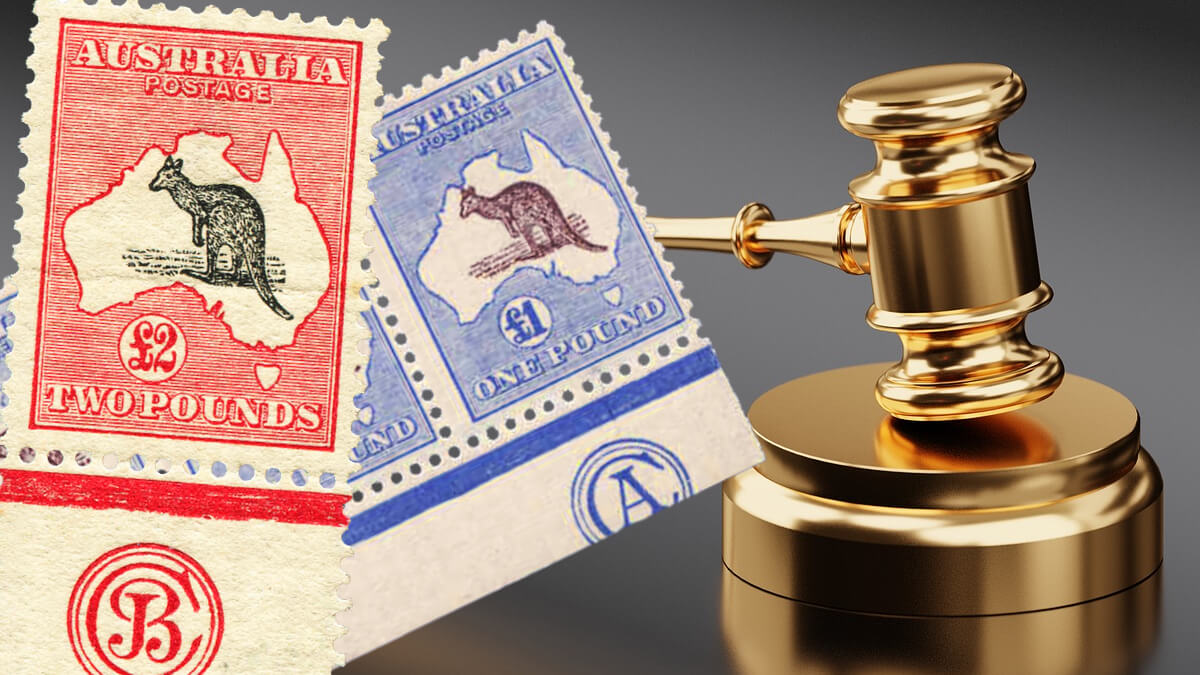
Edit: This post was written as an auction preview. It has been retained in that form, with the auction report added at the bottom.
It’s been a lean year for sports fans. Here in Australia, some of the local football codes are just starting to creep out from COVID-19 hibernation. Many of the world’s other sporting leagues are still on hiatus. Luckily, my favourite spectator sport continues. Ring the bell, it’s time to preview some high-end philatelic auctions!
I champion the joys of frugal stamp collecting. That’s where I spend most of my time. But, like a theatregoer sitting in the cheap seats, admiring the jewellery on the rich people in the dress circle, I also enjoy watching the luxury end of the stamp market. It’s a window onto another world, where extreme rarity meets passionate desire, and well-heeled giants of philately step into the public ring and swing bags of money at each other until one falls over.
Of course, deep down inside, I know it’s hard to justify extravagant sums being spent on postage stamps, just as it’s hard to see millions spent on ancient artworks or superyachts that don’t sail anywhere. And yet, I can’t help hoping that the revolution might spare the lucrative end of the philatelic market just long enough for me to find that one, magical stamp that will draw the millionaires to my humble door, dangling their moneybags in my face. Many are the rarities that once sat unloved at the bottom of a mouldy cardboard box, and I’m a champion rummager.
A few forthcoming auctions contain major philatelic rarities that are likely to send paddles into the air, and prices even higher. (I’m speaking metaphorically. No one’s letting in room bidders right now.) I was going to wrap them all up in one article, but I just realized that the first of them is to be held a little over 24 hours after I publish this. So while I chase up some permissions from the others, I’m going to run early with Phoenix Auctions’ sale of the O’Rourke Kangaroos.
This is a good thing, because it means I can tell you about one of the craziest quirks of Australian philately. Come with me into a world where ginormous prices are paid not for what’s on a stamp, but what’s in its margins.
Some quick background. The six colonies that federated in 1901 to become the Commonwealth of Australia took their sweet time to issue stamps with ‘Australia’ on them. Apart from some postage-dues and postal stationery, the first stamp series designated ‘Australia’ only appeared in 1913. It was the iconic ‘Kangaroo and Map’ series, affectionately known as the Roos. It was a stunningly modern design at the time, and all the better for not kowtowing to the King. It teed the local monarchist lickspittles right off.
I won’t tell you all about the Roos here. Suffice it to say that it’s a hugely popular collecting field, spanning 35 years, 16 values, and five watermarks, with all the proofs, errors, varieties, shades, dies, forgeries, overprints, perfins and other malarkey that you’d expect from a classic series.
But none of that is important right now. What IS important is who printed them.
A number of printers produced these stamps over the years, working by government authority. In the earliest days, two ye-olde fancy monograms appeared in the bottom selvedge of the printing plates: ‘CA’, for Commonwealth of Australia, and ‘JBC’, for the printer J.B. Cooke.
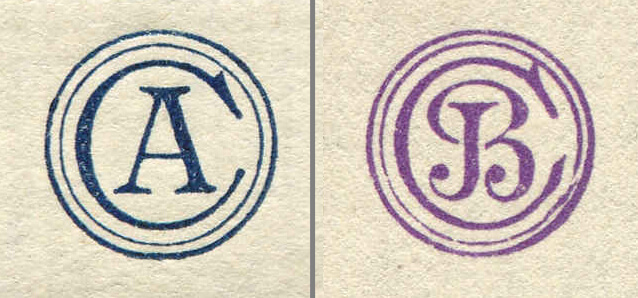
These monograms are really scarce. It’s easy to understand why: they appeared under only one stamp in a pane, and the selvages would often have been removed. And the highest Roo values saw very little use because they were so expensive, so they’re already scarce even without the monograms.
At some point in relatively recent history, prices for these monograms went ballistic. Even part-monograms sell for stupid money. The sweetest coin is reserved for strips of three stamps with the monogram underneath them. Then there are the ‘No Monograms’, which aren’t stamps without monograms, they’re stamps in a certain position where monograms were added later, but hadn’t been yet. Got it?
The monograms didn’t last long. From 1918, they were replaced by a variety of written inscriptions known as ‘imprints’, which generally appeared beneath the central gutter and are also valuable, and usually collected in the form of what are known as ‘imprint blocks’.
Melbourne auction house Phoenix Auctions will shortly hold two auctions: a World Philatelic Auction on Saturday 13 June 2020, preceded on Friday 12 June 2020 by Auction #80, the O’Rourke Kangaroos. Vendor Peter O’Rourke started collecting as a child and subsequently built a Roos collection that won a Large Gold Medal in 2015. In the interim, he made a mint out of mining, which would have helped. The auction catalogue notes: “Peter has developed the most comprehensive collection of Monograms & No Monograms and these have been enhanced with many watermark and printing errors.”
Side note: philatelic awards. Forget gold, silver, and bronze; in competitive philatelic exhibiting, all three exist, but there are Medals, and then there are Large Medals. And between silver and gold, there’s vermeil (and Large Vermeil), and I have only just now looked that up to find out what ‘vermeil’ even means. It’s a thing! It’s silver, plated in gold. How about that?
I want to be clear that these are not the only items on offer at the auction. Lots of cheaper material is also up for grabs. There are also items in the thousands or tens-of-thousands range for those who have got it, but don’t want to flaunt it. But to whittle down the size of this preview and those to come, I’m being mercenary: let’s check out what’s estimated to sell for $100,000 Australian dollars or equivalent. We’re talking around about USD $70,000 / GBP £55,000 / EUR €60,000.
In the case of this week’s Roos, they’re nearly all monograms. Let’s go shopping!
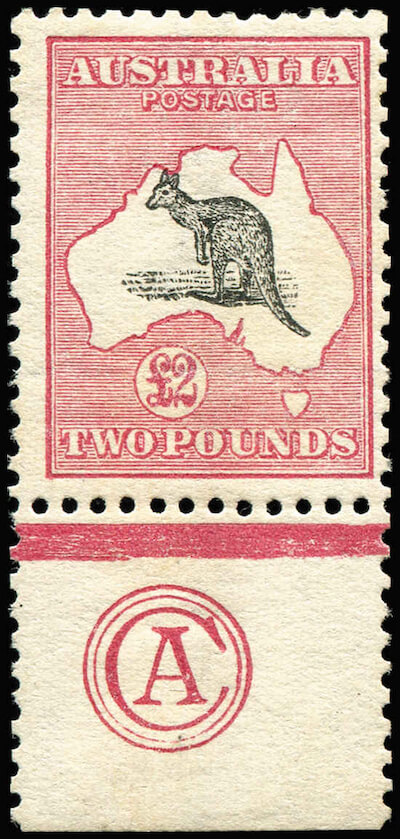
The highest-face-value Roo stamp cost two pounds – a lot of money back in the day, so there aren’t many of this attractive little black-and-rose number around. Lot 122 is a £2 first-watermark single featuring a CA monogram, in mint-very-light-hinged (MVLH) condition. Auction estimate: $120,000 (current catalogue value $175,000). Why so pricey? Only three examples of this stamp with a CA monogram are known. One of those now sits unattainably in Australia Post’s archives; the other has had its selvage rejoined, so, like, ugh. If you’re trying to complete the most perfect Kangaroos collection possible, YOU NEED THIS STAMP. (There are two others with a ‘Specimen’ overprint… long story short, they don’t count.)
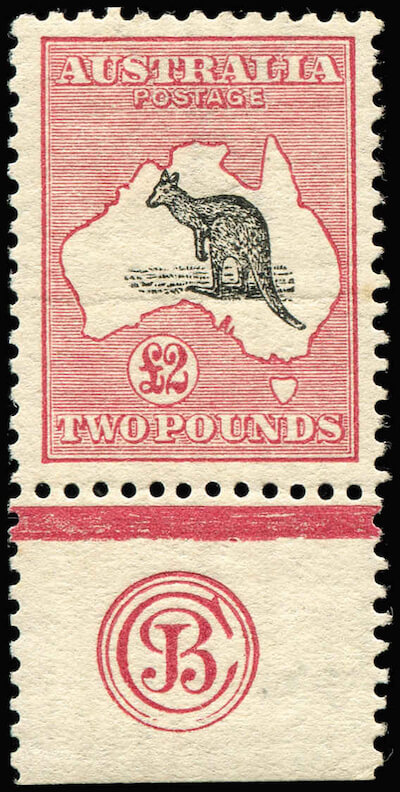
The very next item, Lot 123, is a JBC monogram from the same issue, again MVLH. Auction estimate: $140,000 (catalogue value $200,000). Why is the JBC monogram more valuable than the CA monogram from the same sheet? The answer is ‘availability’. There are also three known copies of this stamp, and Aussie Post has again snaffled one for the archives. The second sits on a strip of three stamps in the freakin’ Royal Collection. So unless you’re planning to get Her Majesty drunk and hope she blurts out the combination to the lock on her stamp dungeon, this is the ONLY copy you can get. Close inspection reveals it has a horizontal crease and a toned perforation, but at this level of rarity, it seems they don’t warrant a mention. In February 2007, this stamp was bought at auction for $US138,000 (then a shade under $A177,000) – a record for a single Australian stamp.
If the asking prices for these two stamps are making your eyes water, consider this: anyone this serious about their first-watermark Roos probably needs to buy BOTH of them.
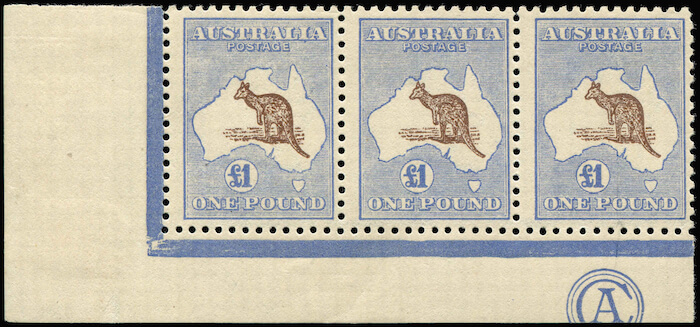
Lot 234 moves us along to the £1 value of the third watermark. This kangaroo’s colour is often described as ‘chocolate’ and that never fails to make me hungry. Monogram collectors prefer their little squiggles on strips of three rather than on single stamps, and the auction catalogue tells us that this is the only strip of three known to exist on any pound-value stamp. There’s another of these, but the Queen’s got it. You can see who your nemesis will be when you enter this market. Luckily, she’s probably distracted by Prince Andrew this week. MVLH condition; auction estimate $100,000 (catalogue $200,000). Good luck.
(To give you an idea of the kind of material I’ve left out of this wrap-up, there are three single JBC monograms of this stamp; the Queen’s got one, and the other two are also in this auction. But they’re only estimated at $50,000. That bargain basement price tag just doesn’t cut it here at Auction Watch.)
Collectors can learn from watching market prices, and the lesson here is: check your kangaroos for monograms (and imprint blocks)! They are also found on the subsequent series of King George V stamps. If you find one among the lowest values, you’re only looking at about $1000 value, not a hundred grand, but still, that’s about a thousand dollars more than your run-of-the-mill one-penny red is worth.
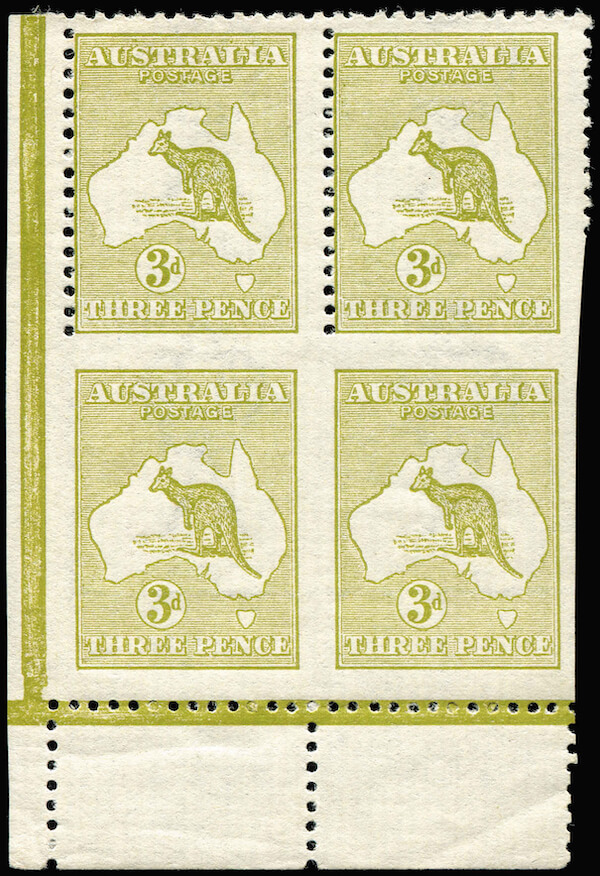
To round out this preview, I will add that the only other piece with a six-figure estimate is Lot 47, a first watermark 3d olive block of four with the lower units imperforate on three sides. Imperf errors are extremely rare on kangaroo stamps. This is one of two such blocks. Interestingly, it’s estimated at $120,000 despite only having a catalogue value of $95,000; the auctioneers must figure that something has changed since the catalogue came out.
I’ve highlighted these items entirely based on their auction estimate. It’s possible that other stuff will sell for stratospheric figures. There are a bunch of items catalogued at $100,000+ that have been estimated below that figure. It’s also possible that those pictured above won’t make their estimate – it depends who’s on the phone or the internet when the auctioneer calls for bids. And who can predict the effect of the slumping world economy on high-end philatelic auctions? Could it be that just when the 99% are re-embracing the hobby as a lockdown pursuit, the 1% start holding their cash a little more tightly because their fossil fuel shares are tanking? Who knows? It only takes two willing buyers to create a contest. Then again, at this level, it only takes one old rich guy to die and the market for the material is halved. In either case, I’ll be watching on with interest as I rummage through a mouldy cardboard box. Pass me the chocolate.
If all goes to plan, I’ll be back again soon with some more impressive stamp candy set to go to auction within the month. And I’ll let you know how this one went. My thanks to Phoenix Auctions for permission to use the images depicted on this page.
AUCTION REPORT:
Results OK, but monograms not jumping so high
Added 22 June, 2020
Well, given the current economic climate, the good news is that, overall, stuff sold. There seemed to be some decent results at the lower and mid-priced sections of the market, particularly among the catalogue-listed varieties. By ‘decent results’, I mean that lots sold for at least the reserve, which you’d assume is the minimum that the vendor wants. No doubt both vendor and auctioneer would have preferred bidding wars to send prices beyond their estimates, but still, selling at reserve is better than watching bidders sit on their paddles all day.
A couple of cheaper lots went for a significantly higher percentage more than their estimates: two third-watermark 9d ’Roo freaks, estimated at $500 each, went for $2,600 (a partially-printed-on-gummed-side error) and $2,100 (partially imperforate). A first watermark 5d chestnut ’Roo with a double perforation error was estimated at $300, but sold for $1700.
The standout observation for me was that, for an auction of a collection specialising in Kangaroo monograms and imprints, surprisingly few of the monograms and imprints hit their estimates. I don’t know enough to judge how optimistic those estimates were, but most of them seemed to me to be priced sensibly below catalogue. Plenty seem to have been snapped up at the reserve; some, including those in the five-figure range, are still looking for buyers.
And what of the big-ticket items, those with the six-figure estimates that I previewed so breathlessly ahead of the auction that you haven’t had a wink of sleep since, waiting to find out how they went?
Only one sold on the day! That was the third-watermark £1 chocolate-and-dull-blue strip-of-three with the partial CA monogram. Living up to its status as the feature lot on the front cover of the printed catalogue, it topped auction day results at $90,000 (from a reserve of $75,000). Add the buyer’s fee of 19.25% and the lucky winner is handing over $107,325.
As for the other three items featured in my review, it seems the splashier end of the collector market went AWOL. Both £2 monograms and the imperforate 3d olive block failed to raise a bid on auction day. But a look at the auction website reveals that each of them has subsequently been snapped up – and for some oddly specific amounts:
Lot 47 (3d part-imperforate block): $86,842.11 (estimate $120,000)
Lot 122 (£2 CA monogram): $86,842.11 (estimate $120,000)
Lot 123 (£2 CA monogram): $101,315.78 (estimate 140,000)
In the course of writing this report, I was scratching my head trying to calculate how those figures had come about. The answer was staring me in the face. The three, added together, amount to the satisfying figure of $275,000. Punk Poirot deduces that a single buyer has corralled all three into a lump-sum offer, and that sum has been distributed across the three lots in percentage terms based on their estimates. (Good luck to catalogue describers the next time one of the pieces hits the market.)
Assuming the buyer’s fee has been added, that’s $327,937.50. So the big money was still out there. Eventually.
What to make of this apparent reduction in enthusiasm for monograms? Perhaps the auction flew under the radar as COVID-19 took high-end collectors’ eyes off the ball. Perhaps the plummeting world economy has drawn the purse strings tighter.*
But I have another theory. Fifteen to twenty years ago, several gazillionaires swamped the Australian philatelic market, outbidding each other for high-end Roos. Now that some of them have left the market, perhaps the rest of the market has decided that the rich guys went a bit stupid specifically on the monograms. The collector market for other Roos seems generally intact. This is not a crash. It’s a long-overdue correction. And I’m prepared to add my monogram to that.

* Side note: rare stamps often don’t suffer the same falls in value as other assets during economic downturns. Rarity is ageless. As long as there are still stamp collectors prepared to pay for that rarity, your asset remains intact. Just make sure you don’t overpay for that rarity in the first place.
You don’t need to be a millionaire to catch the philatelic bug. Get on board! Hit the Follow button or submit your email to read new posts as soon as they appear! You can also find me on Facebook, Twitter, and Instagram.
Discover more from Punk Philatelist
Subscribe to get the latest posts sent to your email.

Terrific post, wonderfully interesting!
I can learn the particulars of any stamp by referencing my catalogs, but when you learn the narrative behind the stamps it truly brings them to life.
As collectors we all have stories about our best stamps, and not just the pricey ones. Many of my favorites are worth pennies, yet I have on numerous occasions bored my wife to tears telling tales of where I found this stamp or what I love about that stamp.
Outstanding work, Sir!
LikeLiked by 1 person
Thanks Robert! You’re right, it’s one thing to know what’s valuable, but it’s usually far more interesting to know why. I’m sure your wife secretly loves your stamp stories. Mine does! I can tell by the glaze of wonder that crosses her eyes.
LikeLiked by 1 person
“The second sits on a strip of three stamps in the freakin’ Royal Collection. So unless you’re planning to get Her Majesty drunk and hope she blurts out the combination to the lock on her stamp dungeon, this is the ONLY copy you can get.”
And people say philatelic writing is boring! Thank you!!
LikeLiked by 1 person
Well SOMEONE had to expose the stamp dungeon! Thank you!
LikeLiked by 1 person
Ini salah satu perangko roo harta karun Australia sangat indah sekali. Saya menemukan perangko menjadi ikon dunia menurut saya.
LikeLiked by 1 person